



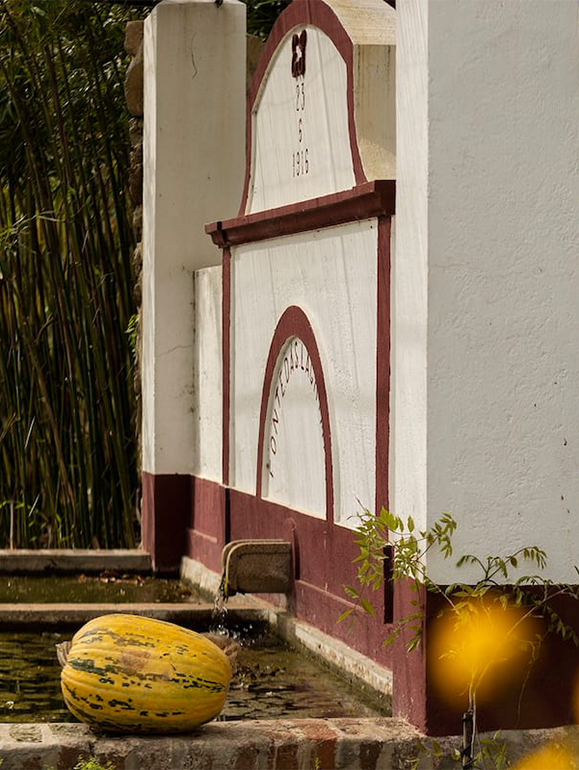
The Gião Fountain, a baroque masterpiece erected on October 5, 1898, is a masterful expression of arched masonry architecture. This monument stands out for its decorative richness, featuring composite pilasters, fire pits and ornamental urns. Its facade is adorned with baroque elements such as sea stars, anthropomorphic masks and stylized hearts.
Access to the fountain is marked by an elegant round arch, framed by a blind arcade, red stile details adorn the moldings and gable, giving a touch of sophistication. Two large resting benches carved from granite complement the surrounding area.
These characteristics make Fonte do Gião a true piece of art that testifies to the artistic mastery of the period.

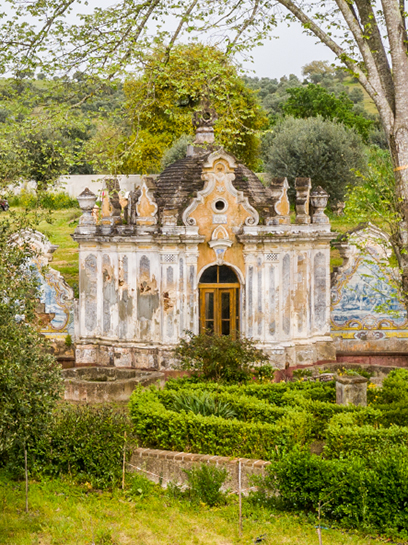
The Fonte das Lágrimas (Fountain of Tears), mentioned around 1758, is a water feature decorated in the rococo style. Featuring an interior bowl carved in white marble, following the rhomboidal pattern, and a frieze of polychrome tiles from the 18th century, this fountain exhits the Moor tradition. It is a remarkable expression of the artistic richness of the time, where water becomes an element of beauty.

Four large rococo tile panels, dating from around 1780, decorate the benches, representing symbols of the seasons. These pieces, from the Real Fábrica do Rato, are an important artistic feature of the period. The monochrome blue tiles, with curved bars and greenish tones, artistically illustrate the passage of time.

The Fonte Monumental (Monumental Fountain), built in the 18th century, stands out in the farm’s landscaping. In the Alentejo Baroque style, it has a U-shaped plan with a central pavilion covered by a radiated dome. The rococo tile panels, dating from around 1780, display symbols of the seasons. The facade is adorned with pilasters, fireworks and ornamental urns, creating a majestic atmosphere.

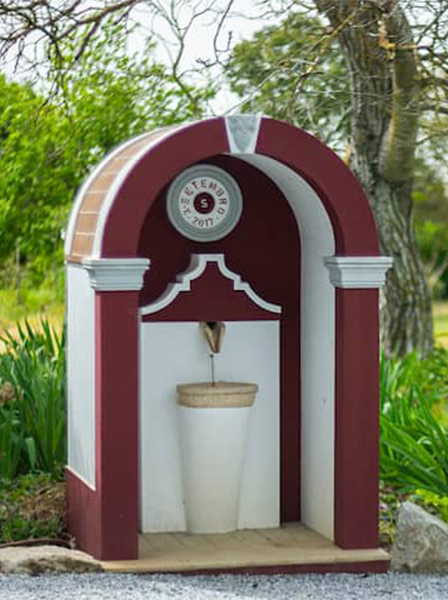
The rustic Entrance Gate greets visitors with its molded pilasters, ellipsoid lunette and decorated gable. Its structure, enriched with flaming pinnacles, offers an imposing entrance, marking the transition to a historic journey through the farm.

The Izaura Castle, built in 1914, stands out as a unique piece among the fountains at Quinta da Asneira. Its uniqueness lies in the representation of a castle, made up of two main bodies covered with stones of various colors, which intertwine to form charming designs. The central body simulates the grandeur of a cylindrical castle tower, crowned with characteristic battlements and merlons.
In the center of the castle, stones take the form of intricate characters, adding a touch of mystery to the structure. A notable detail is the presence of an anthropomorphic clay gargoyle, through which water flows elegantly, feeding a curious horseshoe-shaped tank. Around the tower, two resting benches, adorned with the same battlements and merlons, give the authenticity of a castle walls, providing a charming place for rest and contemplation.

The Monumental Fountain, a historical jewel of Quinta da Asneira, has its roots in the 18th century, when it was built with the aim of beautifying the farm's setting. Built in the Alentejo Baroque style, its majestic presence stands out in the landscape, captivating visitors over the centuries.
With an elegant U-shaped plan, the Monumental Fountain embraces a central pavilion crowned by a radiating dome, an architectural masterpiece that transcends time. Dating from 1705-1893, this fountain tells the story of the eras, witnessing changes and preserving the essence of different periods.
The façade, richly adorned with composite pilasters and other baroque elements, is a testament to the artistic expertise of the time. The ornamental fires and urns enrich the structure, giving it a unique elegance.
The Monumental Fountain is more than an architectural piece; it is a link to the past, a silent witness to events that shaped the farm's history. Rococo tiles, dating from around 1780, display symbols of the seasons, adding an artistic and symbolic dimension to the fountain.
Over the years, the Monumental Fountain has been carefully preserved, remaining a living manifestation of the historical and cultural richness of Quinta da Asneira. Its role transcends functionality, acting as a central piece in the architectural and artistic legacy that continues on the farm to this day.
The evolution of art in Montemor-o-Novo is intrinsically linked to the rich history and cultural heritage, with Quinta da Asneira standing out as an important vector of this artistic expression over the centuries. In a context where water plays a crucial role in the life of the community, from water supply to agricultural practices, Montemor-o-Novo has witnessed the flourishing of various forms of art.
From Roman times to Islamic influence, ingenuity in water management has shaped the urban and rural landscape. Mills powered by water and Roman aqueducts are tangible examples of this technical mastery, demonstrating the ability to use natural resources efficiently.

Quinta da Asneira, over the centuries, reflects this artistic evolution. From the baroque elements present in the Fonte do Gião, with its decorative pilasters and ornamental urns, to the rococo tiles on the panels that adorn the Fonte Monumental, the farm is a visual testimony to the stylistic diversity that permeated Montemor-o-Novo.
Water, in addition to fulfilling practical functions, served as inspiration and an integrating element in local artistic production. Fountains and wells were not only sources of water supply, but also spaces for coexistence and socializing. Going to the fountain was not just a daily task, but an opportunity for rest, socialization and even dating.
The architecture of Quinta da Asneira, with its imposing Entrance Gate and Monumental Fountain, is a reflection of the influence of different artistic periods in Montemor-o-Novo. Baroque and Rococo, with their ornate forms and symbolism, find expression in the structures that make up the farm.
Montemor-o-Novo, with its rich history and Quinta da Asneira as a focal point, preserves and celebrates the evolution of art over time, incorporating water as a vital element in both the daily life and artistic expression of the community.
Intramuros Nucleus of Montemor-o-Novo
History of the Military Order of Santiago de Espada
Quinta do Gião Fountain / Quinta da Asneira Fountain / Quinta do Pumarinho Fountain
Book Brief Guide to Gothic and Manueline Art in the Municipality of Montemor-o-Novo:
Túlio Túlio Espanca Artistic Inventory of Portugal-Évora District- Vol. VIII- Lisbon- 1975
Book "Viagem a Portugal", José Saramago
Book Almonsor vol.3 2004
Historical and Artistic Evocation of Montemor-o-Novo”, Almansor n1, Montemor-o-Novo, City Council, 1983
Culture Magazine 4th edition 2005
Inventory of Fountains and Water Fountains in the Municipality of Montemor-o-Novo, Montemor-o-Novo City Council 1996, 97, Ana Isabel Branca B. Saraiva

